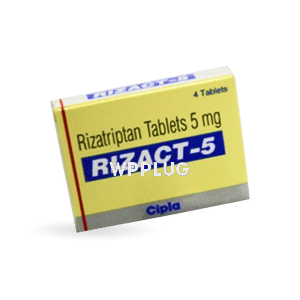
| Product dosage: 10mg | |||
|---|---|---|---|
| Package (num) | Per pill | Price | Buy |
| 8 | $6.88 | $55.04 (0%) | 🛒 Add to cart |
| 12 | $6.38 | $82.56 $76.54 (7%) | 🛒 Add to cart |
| 24 | $5.95 | $165.12 $142.76 (14%) | 🛒 Add to cart |
| 36 | $5.59 | $247.68 $201.24 (19%) | 🛒 Add to cart |
| 60 | $5.25 | $412.80 $314.76 (24%) | 🛒 Add to cart |
| 88 | $4.98
Best per pill | $605.44 $438.60 (28%) | 🛒 Add to cart |
| Product dosage: 5mg | |||
|---|---|---|---|
| Package (num) | Per pill | Price | Buy |
| 8 | $5.48 | $43.86 (0%) | 🛒 Add to cart |
| 12 | $5.16 | $65.79 $61.92 (6%) | 🛒 Add to cart |
| 24 | $4.80 | $131.58 $115.24 (12%) | 🛒 Add to cart |
| 36 | $4.47 | $197.37 $160.82 (19%) | 🛒 Add to cart |
| 60 | $4.13 | $328.95 $247.68 (25%) | 🛒 Add to cart |
| 88 | $3.96
Best per pill | $482.46 $348.30 (28%) | 🛒 Add to cart |
Rizact: Advanced Migraine Relief with Rizatriptan
Rizact is a prescription medication specifically formulated for the acute treatment of migraine attacks with or without aura in adults. It belongs to the class of drugs known as selective serotonin receptor agonists (triptans), which work by narrowing blood vessels around the brain and reducing substances in the body that can trigger migraine pain, nausea, sensitivity to light and sound, and other migraine symptoms. This product card provides a comprehensive, expert-level overview of Rizact, detailing its mechanism, appropriate use, and essential safety information for healthcare professionals and informed patients. It is not a substitute for professional medical advice, diagnosis, or treatment.
Features
- Active Ingredient: Rizatriptan Benzoate
- Available Strengths: 5 mg and 10 mg orally disintegrating tablets (ODT) and standard tablets
- Drug Class: Selective 5-HT1B/1D receptor agonist (Triptan)
- Administration: Oral
- Mechanism of Action: Binds with high affinity to 5-HT1B and 5-HT1D receptors, mediating cranial vasoconstriction and inhibition of pro-inflammatory neuropeptide release.
Benefits
- Provides rapid relief from the debilitating pain of a migraine attack, often within 2 hours for a significant proportion of users.
- Effectively alleviates associated migraine symptoms, including nausea, vomiting, photophobia (sensitivity to light), and phonophobia (sensitivity to sound).
- The orally disintegrating tablet formulation offers a convenient administration option, especially for patients experiencing nausea or difficulty swallowing, as it can be taken without liquid.
- Offers a favorable efficacy profile with a well-established safety record for the acute treatment of migraine in appropriate patient populations.
- Helps restore normal function and reduces disability during a migraine episode, allowing for a quicker return to daily activities.
Common use
Rizact is indicated for the acute treatment of migraine with or without aura in adults. It is intended for use at the onset of a migraine headache. It is not indicated for the prophylactic (preventive) therapy of migraine, for the management of hemiplegic or basilar migraine, or for the treatment of cluster headaches. Its use should be reserved for patients with a clear diagnosis of migraine. It is not effective for other types of headache (e.g., tension-type headaches).
Dosage and direction
The recommended dose is either 5 mg or 10 mg. For most patients, the 10 mg dose is the preferred starting dose. A second dose may be taken if the headache returns but should not be taken within 2 hours of the initial dose. The maximum dose in a 24-hour period is 30 mg. For patients on prophylactic therapy with propranolol, the recommended dose of Rizact is 5 mg, with a maximum daily dose of 15 mg in a 24-hour period. Administration:
- Standard Tablets: Should be taken with fluid.
- Orally Disintegrating Tablets (ODT): The tablet should be placed on the tongue, where it will disintegrate and be swallowed with saliva. No liquid is needed for administration. The ODT blister should be opened only just prior to dosing.
Precautions
- Rizact should only be used where a clear diagnosis of migraine has been established.
- This medication is not intended for use in the management of hemiplegic or basilar migraine.
- As with other triptans, there is a potential for coronary vasospasm; it should not be given to patients with documented ischemic or vasospastic coronary artery disease (CAD).
- Pre-existing hypertension should be controlled before using Rizact. It is not recommended in patients with uncontrolled hypertension.
- Sensations of tightness, pain, pressure, and heaviness in the precordium, throat, neck, and jaw commonly occur after treatment with triptans and are usually non-cardiac in origin. However, if such symptoms are considered to be cardiac in origin, appropriate evaluation should be performed.
- Cerebrovascular events, including stroke and transient ischemic attack, have been reported in association with triptan use. Use is contraindicated in patients with a history of stroke or TIA.
- Medication overuse headache (rebound headache) may develop in patients using acute migraine medications, including triptans, for 10 or more days per month.
Contraindications
- History of ischemic heart disease (e.g., angina pectoris, history of myocardial infarction, or documented silent ischemia)
- Coronary artery vasospasm, including Prinzmetal’s angina
- Uncontrolled hypertension
- History of stroke or transient ischemic attack (TIA)
- History of hemiplegic or basilar migraine
- Peripheral vascular disease
- Ischemic bowel disease
- Hypersensitivity to rizatriptan or any component of the formulation
- Concurrent administration or within 2 weeks of discontinuing MAO-A inhibitors
- Concurrent administration of other 5-HT1 agonists (e.g., other triptans) or ergotamine-containing medications
Possible side effect
The most common adverse reactions are usually mild and transient.
- Very Common (≥1/10): Dizziness, somnolence (sleepiness), fatigue/asthenia.
- Common (≥1/100 to <1/10): Pain/pressure sensations (e.g., chest, throat, neck; typically non-cardiac), nausea, dry mouth, palpitations, tachycardia (increased heart rate), flushing, feeling warm or cold.
- Uncommon (≥1/1,000 to <1/100): Hypertension, hypotension, bradycardia (decreased heart rate), syncope (fainting), abdominal pain, dyspepsia, diarrhea, vomiting, muscle weakness, myalgia, arthralgia, tremor, anxiety, agitation, mental impairment, pruritus (itching), rash, urticaria (hives).
- Rare: Serious cardiac events (myocardial infarction, arrhythmias), cerebrovascular events (stroke, hemorrhage), serotonin syndrome.
Drug interaction
- Monoamine Oxidase-A Inhibitors: Contraindicated. Rizatriptan is metabolized by MAO-A; concurrent use can lead to a significant increase in systemic exposure.
- Propranolol: Coadministration increases the plasma concentration of rizatriptan. The dose of Rizact should be reduced to 5 mg, with a maximum of 15 mg in 24 hours.
- Other Triptans and Ergot Derivatives: Contraindicated due to additive vasoconstrictive effects and increased risk of serious adverse reactions.
- Selective Serotonin Reuptake Inhibitors (SSRIs) / Serotonin-Norepinephrine Reuptake Inhibitors (SNRIs): Concomitant use may potentially increase the risk of serotonin syndrome, a rare but serious condition characterized by mental status changes, autonomic instability, neuromuscular symptoms, and gastrointestinal symptoms.
- Other 5-HT1 Agonists: Avoid concurrent use.
Missed dose
Rizact is not scheduled for regular use. It is taken on an as-needed basis at the onset of a migraine headache. The concept of a “missed dose” does not apply. Do not take a dose to make up for a migraine that was not treated.
Overdose
Symptoms of overdose may include dizziness, drowsiness, fainting, tachycardia, bradycardia, hypotension, hypertension, vomiting, and loss of coordination. In cases of severe overdose, vasospastic reactions or other serious cardiovascular symptoms may occur. There is no specific antidote. Management consists of supportive care, including continuous cardiac monitoring for at least 20 hours and appropriate symptomatic treatment. Hemodialysis is unlikely to be beneficial.
Storage
Store at room temperature between 20°C to 25°C (68°F to 77°F), with excursions permitted between 15°C and 30°C (59°F and 86°F). Protect from light and moisture.
- Standard Tablets: Keep in original blister pack until time of use.
- Orally Disintegrating Tablets: Keep tablets in the original blister package. Do not remove the blister from the outer aluminum pouch until ready to use. The blister pack should be handled with dry hands.
Disclaimer
This information is for educational and informational purposes only and is not intended as a substitute for professional medical advice, diagnosis, or treatment. Always seek the advice of your physician or other qualified health provider with any questions you may have regarding a medical condition or medication. Never disregard professional medical advice or delay in seeking it because of something you have read here. The information provided is not all-inclusive and does not cover all possible uses, directions, precautions, drug interactions, or adverse effects.
Reviews
- “As a neurologist, I find Rizact to be a reliable and effective option for many of my patients with moderate to severe migraines. The ODT formulation is particularly valuable for those with significant nausea. Its rapid onset of action is a key benefit.” – Dr. E. Vance, MD, Neurology
- “The 10mg dose provides consistent relief for my migraine attacks, usually within 90 minutes. I appreciate having the option of the melt-in-your-mouth tablet when I feel too nauseous to drink water.” – Patient, 42
- “In clinical practice, rizatriptan remains a first-line triptan due to its proven efficacy and generally good tolerability profile. It is important, as with all triptans, to carefully screen patients for cardiovascular risk factors prior to initiation.” – Clinical Pharmacist Specialist
- “It works well to stop my migraines in their tracks, but I do sometimes experience a feeling of tightness in my jaw and neck afterwards. For me, the benefit outweighs this side effect.” – Patient, 35