
| Product dosage: 0.25mg | |||
|---|---|---|---|
| Package (num) | Per pill | Price | Buy |
| 32 | $3.06 | $98.04 (0%) | 🛒 Add to cart |
| 48 | $2.85 | $147.06 $136.74 (7%) | 🛒 Add to cart |
| 56 | $2.78
Best per pill | $171.57 $155.66 (9%) | 🛒 Add to cart |
| Product dosage: 0.5mg | |||
|---|---|---|---|
| Package (num) | Per pill | Price | Buy |
| 32 | $5.86 | $187.48 (0%) | 🛒 Add to cart |
| 48 | $5.63 | $281.22 $270.04 (4%) | 🛒 Add to cart |
| 56 | $5.56
Best per pill | $328.09 $311.32 (5%) | 🛒 Add to cart |
Synonyms | |||
Similar products
Dostinex: Effective Prolactin Regulation for Hormonal Balance
Dostinex (cabergoline) is a prescription medication specifically formulated for the treatment of hyperprolactinemia—a condition characterized by abnormally high levels of the hormone prolactin in the blood. As a dopamine receptor agonist, it directly targets the pituitary gland, inhibiting prolactin secretion with high efficacy and a favorable tolerability profile. This makes it a cornerstone therapy for managing prolactin-related disorders, restoring endocrine equilibrium, and addressing associated symptoms. Its long half-life allows for convenient, less frequent dosing compared to other agents in its class.
Features
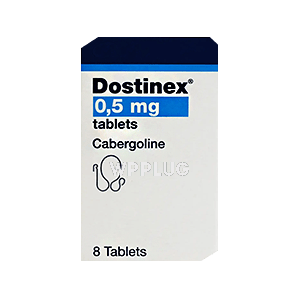
- Active ingredient: Cabergoline 0.5 mg per tablet
- Pharmacological class: Dopamine D₂ receptor agonist
- Administration: Oral tablet
- Manufacturer: Pharmacia & Upjohn (a division of Pfizer Inc.)
- Available in blister packs of 8 tablets
- Long elimination half-life (~63–69 hours) permitting twice-weekly dosing
Benefits
- Effectively normalizes elevated prolactin levels, addressing the root cause of symptoms
- Restores ovulation and regular menstrual cycles in women with hyperprolactinemic amenorrhea
- Reduces or eliminates galactorrhea (inappropriate milk production)
- Improves libido and sexual function in both men and women
- May reduce prolactinoma size in patients with pituitary tumors
- Offers flexible dosing and generally good patient compliance due to twice-weekly administration
Common use
Dostinex is primarily indicated for the treatment of hyperprolactinemia, whether idiopathic or due to pituitary adenomas (prolactinomas). It is used to manage associated conditions such as amenorrhea, infertility, galactorrhea, and hypogonadism. In some cases, it may also be prescribed off-label for the prevention of physiological lactation postpartum or for Parkinson’s disease at higher doses, though these uses are less common and require careful medical supervision.
Dosage and direction
The initial dosage is typically 0.5 mg per week, administered as 0.25 mg twice weekly (e.g., Tuesday and Friday). Dosage may be increased gradually by 0.5 mg per week at monthly intervals, based on prolactin level monitoring, until optimal therapeutic response is achieved. The therapeutic dosage usually ranges from 0.5 mg to 2 mg per week, divided into two or more doses. Tablets should be taken orally with or without food. Dosage adjustments are necessary in patients with severe hepatic impairment.
Precautions
- Use with caution in patients with hepatic impairment; consider lower starting doses.
- Monitor for signs of cardiac valvulopathy and fibrotic reactions with long-term use.
- Blood pressure should be monitored, especially during the initial treatment phase, due to risk of hypotension.
- Patients should be advised about potential drowsiness; caution is required when driving or operating machinery.
- Not recommended during pregnancy unless clearly needed; discontinue once pregnancy is confirmed unless benefits outweigh risks.
- Use in elderly patients should be approached cautiously, starting at the lower end of the dosing range.
Contraindications
- Hypersensitivity to cabergoline, any ergot derivatives, or any component of the formulation.
- History of cardiac valvular disorders, pericardial fibrosis, or pleural fibrosis.
- Uncontrolled hypertension.
- History of pulmonary fibrosis or other fibrotic disorders.
- Concomitant use with other medications known to cause fibrosis (e.g., certain antipsychotics, ergot alkaloids).
Possible side effect
Common side effects include nausea, headache, dizziness, fatigue, and abdominal pain. Less frequently, patients may experience constipation, dyspepsia, vomiting, or orthostatic hypotension. Serious but rare adverse effects include cardiac valvulopathy, pulmonary fibrosis, pleural effusion, and psychiatric disturbances such as hallucinations or impulse control disorders. Most side effects are dose-dependent and may diminish with continued use or dosage adjustment.
Drug interaction
Dostinex may interact with medications that affect dopamine receptor activity, such as antipsychotics (e.g., phenothiazines, butyrophenones) and metoclopramide, which can diminish its efficacy. Concomitant use with other antihypertensive agents may potentiate hypotension. Macrolide antibiotics (e.g., erythromycin) may increase cabergoline plasma concentrations. Avoid concurrent use with other ergot alkaloids due to increased risk of fibrosis.
Missed dose
If a dose is missed, it should be taken as soon as remembered unless it is almost time for the next scheduled dose. In that case, skip the missed dose and resume the usual dosing schedule. Do not double the dose to make up for a missed one.
Overdose
Symptoms of overdose may include severe nausea, vomiting, hypotension, hallucinations, or psychosis. Management is supportive and symptomatic; there is no specific antidote. Gastric lavage may be considered if ingestion was recent. Vital signs should be monitored, and symptomatic treatment for hypotension (e.g., IV fluids, vasopressors) may be necessary.
Storage
Store at room temperature (20–25°C or 68–77°F), in a dry place, protected from light and moisture. Keep out of reach of children and pets. Do not use beyond the expiration date printed on the packaging.
Disclaimer
This information is for educational purposes only and is not a substitute for professional medical advice, diagnosis, or treatment. Always seek the advice of your physician or other qualified health provider with any questions you may have regarding a medical condition or before starting any new treatment. Do not disregard professional medical advice or delay in seeking it because of something you have read here.
Reviews
Clinical studies and patient reports consistently highlight Dostinex’s efficacy in normalizing prolactin levels and resolving associated symptoms, with many users noting improvement within weeks. Its convenient dosing schedule is frequently praised. However, some users report side effects such as nausea or dizziness, which often subside with continued use. Overall, it is regarded as a well-tolerated and effective first-line treatment for hyperprolactinemia when used under medical supervision.