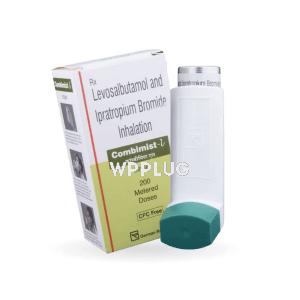
| Product dosage: 50mcg+20mcg | |||
|---|---|---|---|
| Package (num) | Per inhaler | Price | Buy |
| 2 | $25.80 | $51.60 (0%) | 🛒 Add to cart |
| 3 | $23.22
Best per inhaler | $77.40 $69.66 (10%) | 🛒 Add to cart |
Combimist L Inhaler: Advanced Dual-Action Asthma and COPD Control
Combimist L Inhaler is a prescription-only metered-dose inhaler designed for the maintenance treatment of reversible obstructive airways diseases, including asthma and chronic obstructive pulmonary disease (COPD). It combines two active pharmacological agents—Levosalbutamol and Ipratropium Bromide—in a single, convenient device. This synergistic formulation provides both rapid bronchodilation and sustained airway control, targeting different pathways of bronchoconstriction for comprehensive respiratory management. It is indicated for patients requiring regular bronchodilator therapy to manage symptoms and improve lung function.
Features
- Dual Active Ingredients: Contains Levosalbutamol (the pharmacologically active R-enantiomer of salbutamol) 50 mcg and Ipratropium Bromide 20 mcg per puff.
- Mechanism of Action: Levosalbutamol is a selective short-acting β2-adrenergic receptor agonist (SABA) that relaxes bronchial smooth muscle. Ipratropium Bromide is an anticholinergic agent that blocks muscarinic receptors, inhibiting cholinergic bronchoconstriction.
- Delivery System: Hydrofluoroalkane (HFA) propelled metered-dose inhaler (MDI), ensuring consistent and precise dosing with each actuation.
- Dosage Formulation: Each delivered dose (ex valve) contains Levosalbutamol 47 mcg and Ipratropium Bromide 17 mcg.
- Onset and Duration: Bronchodilation typically begins within 5-15 minutes, peaks within 1-2 hours, and persists for up to 6 hours.
Benefits
- Superior Bronchodilation: The complementary mechanisms provide more effective and reliable opening of the airways compared to monotherapy with a single agent.
- Symptom Control: Effectively relieves wheezing, shortness of breath (dyspnea), chest tightness, and coughing associated with obstructive lung diseases.
- Improved Exercise Tolerance: By optimizing airway function, it allows for increased physical activity and enhanced quality of life.
- Convenience of Combination Therapy: Simplifies treatment regimens by combining two medications into one inhaler, potentially improving patient adherence.
- Rapid Onset of Action: Offers quick relief from acute bronchospasm, making it suitable for both scheduled and as-needed use per physician guidance.
Common use
Combimist L Inhaler is primarily used for the maintenance treatment of bronchospasm associated with reversible obstructive airway diseases. This includes:
- Asthma: For patients whose symptoms are not adequately controlled on a single short-acting bronchodilator.
- Chronic Obstructive Pulmonary Disease (COPD): Including emphysema and chronic bronchitis, for the relief of bronchospasm and its associated symptoms. It is not intended for the initial relief of acute asthma attacks where a rescue inhaler (e.g., a SABA alone) may be more appropriate, though it can be used on a schedule to prevent such occurrences.
Dosage and direction
The dosage must be individualized based on the severity of the condition and patient response. It is critical to follow the prescribing physician’s instructions exactly.
- The usual recommended dose for adults and children over 12 years is two puffs, taken four times a day.
- Shake the inhaler well before each use.
- Exhale fully away from the mouthpiece.
- Place the mouthpiece between your lips, forming a tight seal.
- Begin to inhale slowly and deeply through your mouth, and simultaneously press down firmly on the canister to release one puff.
- Continue to inhale deeply until your lungs are full.
- Hold your breath for about 10 seconds, or for as long as is comfortable, to allow the medication to deposit in the airways.
- Wait about one minute before administering the second puff if required.
- Rinse your mouth with water after each use to help prevent potential oral thrush and dryness.
Precautions
- Paradoxical Bronchospasm: The inhaler can itself cause life-threatening bronchospasm. If this occurs, discontinue use immediately and institute alternative therapy.
- Cardiovascular Effects: Use with caution in patients with cardiovascular disorders (e.g., coronary insufficiency, cardiac arrhythmias, hypertension), as beta-agonists can cause significant cardiovascular effects such as tachycardia and elevated blood pressure.
- Metabolic Effects: Beta-agonists may produce significant hypokalemia and hyperglycemia, especially in diabetic patients. Serum potassium and blood glucose should be monitored periodically.
- Ocular Effects: The anticholinergic agent may cause blurred vision, pupil dilation, and precipitation or worsening of narrow-angle glaucoma. Advice patients to avoid getting the spray in their eyes.
- Renal/Hepatic Impairment: Use with caution in patients with impaired renal or hepatic function.
- Pregnancy and Lactation: Should be used during pregnancy or breastfeeding only if the potential benefit justifies the potential risk to the fetus or infant. Category C.
Contraindications
Combimist L Inhaler is contraindicated in patients with a history of hypersensitivity to Levosalbutamol, Ipratropium Bromide, atropine, its derivatives, or any other component of the formulation. It is also contraindicated in patients with a known hypersensitivity to soya lecithin or related food products such as soybean and peanut.
Possible side effect
While not all patients experience side effects, the following have been reported:
- Common: Headache, cough, dry mouth, hoarseness, throat irritation, nausea, nervousness, tremor, dizziness.
- Less Common: Palpitations, tachycardia, paradoxical bronchospasm, blurred vision, difficulty in micturition, urinary retention.
- Rare: Allergic reactions (e.g., skin rash, angioedema), hypokalemia, increased blood pressure, glaucoma, supraventricular tachycardia.
Drug interaction
Concurrent use with other drugs may potentiate the risk of adverse effects:
- Other Beta-adrenergic Drugs: Additive sympathomimetic effects and increased risk of cardiovascular side effects.
- Diuretics and Xanthine Derivatives: May potentiate the hypokalemic effect of beta2-agonists.
- Monoamine Oxidase Inhibitors (MAOIs) and Tricyclic Antidepressants (TCAs): May potentiate the vascular effects of beta-agonists.
- Other Anticholinergic Drugs: Concomitant use may increase anticholinergic adverse effects. Always inform your healthcare provider of all medications you are taking, including prescription, over-the-counter, and herbal products.
Missed dose
If a dose is missed, it should be taken as soon as remembered. However, if it is almost time for the next scheduled dose, the missed dose should be skipped, and the regular dosing schedule resumed. Do not double the dose to make up for a missed one.
Overdose
Overdosage may manifest as an exaggeration of the known pharmacologic effects, including severe anginal pain, significant hypertension or hypotension, tachycardia with rates up to 200 beats per minute, nervousness, headache, tremor, dry mouth, palpitation, nausea, dizziness, fatigue, malaise, and hypokalemia. Severe anticholinergic effects such as blurring of vision, urinary difficulty, and gastrointestinal disturbances may also occur. Treatment is supportive and symptomatic. Cardiac monitoring is recommended. Dialysis is not appropriate.
Storage
- Store at room temperature (15°C to 30°C). Protect from frost, direct sunlight, and heat. Do not puncture or incinerate the canister, even when empty.
- Keep the canister away from eyes and skin.
- Keep out of reach of children.
Disclaimer
This information is for educational purposes only and is not a substitute for professional medical advice, diagnosis, or treatment. Always seek the advice of your physician or other qualified health provider with any questions you may have regarding a medical condition or before starting any new treatment. Never disregard professional medical advice or delay in seeking it because of something you have read here.
Reviews
- “As a pulmonologist, I find the dual mechanism of Combimist L to be highly effective for my moderate COPD patients who need more than a single-agent reliever. The convenience of a combination inhaler significantly improves compliance.” – Dr. A. Sharma, MD.
- “This inhaler has been a game-changer for managing my asthma. The relief is faster and lasts longer than my previous inhaler. The two-in-one formula means one less device to carry.” – Patient, 48.
- “Noticeable improvement in baseline dyspnea and exercise capacity within a week of switching to this regimen. Side effects were minimal (mild dry mouth).” – Patient, 65.
- “From a clinical pharmacy perspective, the pharmacokinetic profile is favorable. However, patient education on proper inhaler technique is paramount to its efficacy and to minimize local side effects.” – Clinical Pharmacist.